
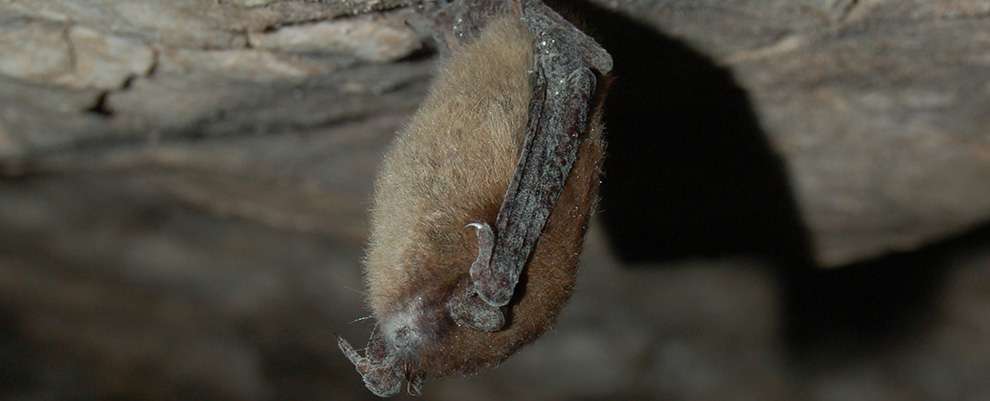
The BC Community Bat Programs, in collaboration with the Province of BC, are asking the public for help in the effort to detect and prevent the spread of white-nose syndrome (WNS) in bats. Residents are urged to report any bat activity observed in winter and any sick or dead bats found before May 31st.
There have not been any bats with WNS found to date in BC, but Pseudogymnoascus
*Destructans (*Pd), the fungus that causes the disease, was confirmed in 2022 in the Boundary Region. Recently, the B.C. Ministry of Water, Land and Resource Stewardship released results from 413 samples taken last winter and spring of 2024, and they all came back as negative. “This was surprising, but great news, as bats with WNS have been confirmed in Alberta and in northern Washington State, just south of the border,” says Paula Rodriguez de la Vega, Provincial coordinator for the BC Community Bat Programs.
First detected in New York State in 2006, the disease continues to spread, with detections in northwestern and central Washington and in south-central Alberta. The fungus does not cause disease in humans and pets, but WNS has devastated North American bat populations. The fungus attacks bats while they are hibernating, growing on their faces to give an appearance of a white nose. Bats often wake to clean the fungus from their skin. This uses valuable energy, and eventually the bats die from starvation.
“Across North America, millions of bats have been killed, and seven of our 15 BC species could be severely affected by the disease,” says Rodriguez de la Vega. The Little Brown Myotis and the Northern Myotis are both listed as Endangered in Canada due to WNS. Though there is not yet a proven cure for WNS, several promising treatment options are being developed, and it may be possible to mitigate the effects of this wildlife health crisis.
If you find a dead bat or have sightings of winter bat activity, please report dead bats here, or by reaching out to your region’s coordinator. All live bats should be left alone — keep your distance, snap a photo and report it to us. If you must move a bat, visit bats and human health page for advice and never touch a bat with your bare hands. Please note that if you or your pet has been in direct contact with the bat you will need further information regarding the risk of rabies to you and your pet. Contact the BC Community Bat Programs for more information. “The more bat reports from the public that we receive, the better we can understand how WNS might spread and affect local bat populations,” says Rodriguez de la Vega.
The bats of BC are key predators of many night-flying insects. They are essential parts of BC’s ecosystems and provide a huge economic benefit by helping control agricultural, forest, and urban pests. In partnership with the BC Ministry of Water, Land and Resource Stewardship, the BC Community Bat Programs provide information and promote local stewardship and citizen science. The programs are supported by funding from the Habitat Conservation Trust Foundation, Forest Enhancement Society of BC, the Habitat Stewardship Program, the Province of BC, and many regional partners. You can find out more about the BC Community Bat Programs and options for helping local bat populations on this website, by emailing us at bcbats@gmail.com or call out hotline 1-855-922-2287.