
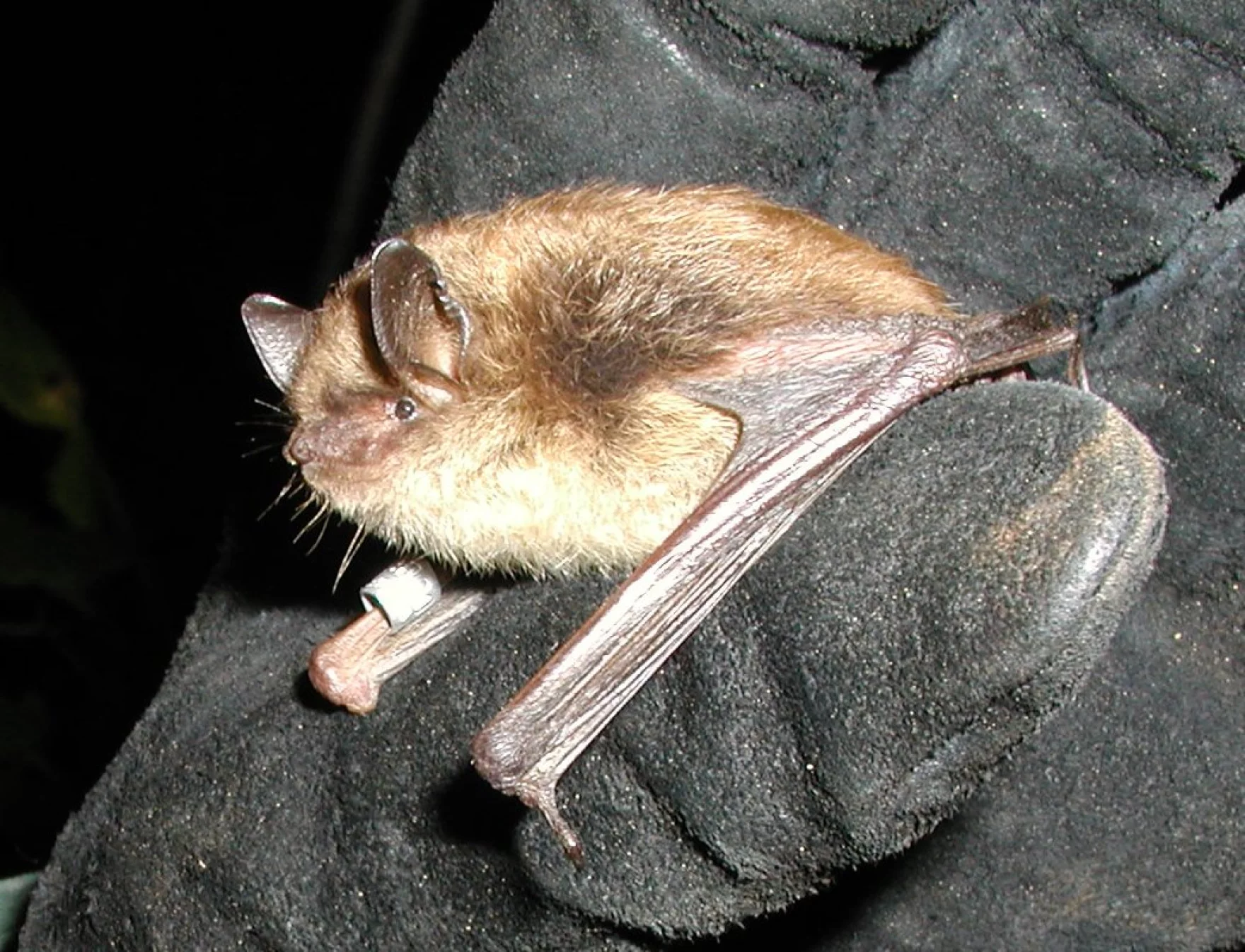
Bats are among the most misunderstood animals in British Columbia, and among the most useful. They are the only mammals that can truly fly, they eat vast numbers of insects, and BC has more kinds of bats than any other province. Below are the questions people ask us most often. If yours isn’t here, get in touch.
What bats are like.
BC is home to at least sixteen species of bats, more than any other province. Here’s how they live. For more, see Bat basics and our species guide.
Are bats blind, or will they fly into my hair?
Neither. Bats are not blind, and there is no attraction whatsoever to human hair. On a summer evening a bat may seem to swoop toward you, but it’s chasing insects, not you, people give off heat and carbon dioxide that draw flying insects, and walking stirs up more. Bats have exceptional flight and easily avoid collisions, with the exception of juveniles still learning to fly.
What do bats eat?
Bats in BC eat arthropods, insects and arachnids such as spiders. Smaller bats take mosquitoes, midges, lacewings, small moths and caddisflies; larger bats handle big moths and hard-bodied beetles, many of them agricultural and forestry pests. Their appetite is enormous: a lactating female may eat her own body weight in insects in a single night, and in a lab one little brown bat ate 600 mosquitoes in an hour. A colony of 100 bats can consume around 350,000 insects a night. Studies in the United States have valued this pest control at roughly $74 an acre, or $3.7 billion a year.
How big are bats?
Smaller than most people expect. The province’s smallest, the western small-footed bat, weighs about 4.5 grams with a 22 cm wingspan; its pups weigh about a gram at birth and are the size of a kidney bean. The largest, the hoary bat, weighs 28.5 grams and spans 39 cm. The bats people encounter most, little brown myotis, Yuma myotis and big brown bat, are small: a little brown bat weighs 6 to 7 grams, about the same as a loonie.
How long do bats live?
Remarkably long for such small animals. There are few lifespan records for BC bats, but in Canada big brown bats have survived at least 19 years and little brown bats more than 39. In the UK, a male Brandt’s bat, a type of Myotis, was found to be 41 years old. This extended longevity is unusual in a small mammal, and researchers are studying it closely.
How many pups do bats have?
Very few. Most bat species in Canada produce a single pup per year, born in June and flying by July. The exceptions, hoary, silver-haired, pallid and red bats, and some big brown bat populations, have twins. Only about half of pups survive their first winter, which is one reason bats are so vulnerable to population decline.
Are bats rodents, like mice?
No, and they won’t breed like them either. Bats are only very distantly related to mice and rats, which belong to the order Rodentia. Bats have their own order, Chiroptera, meaning “hand-wing.” There are over 1,000 species of bats worldwide, making Chiroptera the second-largest order of mammals. Bats are protected under the BC Wildlife Act.
What do bats do in the winter?
Most BC bats hibernate: their body temperature drops, their heart rate slows and their metabolism falls dramatically. Others migrate south, hoary and red bats are fully migratory, travelling as far as Mexico or Central America, while silver-haired bats are “migratory-hibernators.” Bats living in buildings usually leave in autumn to hibernate in a cave or mine, though a few species stay active through winter in BC.
Are they a risk?
Bats are not aggressive and pose little risk when left alone. Here’s the honest picture on rabies, guano and disease, see also Bats & human health.
Are bats dangerous?
Bats are not aggressive and will not intentionally attack people or other animals. Like all wildlife, they should be left alone and not handled. Take extra care in two situations: a bat somewhere it isn’t welcome, such as inside a home, and a bat acting oddly, such as one on the ground near people. A bat flying inside a home will often leave on its own if you open the doors and windows. A bat on the ground is more likely to be sick and should be treated with caution.
Do bats carry rabies?
Bats are the only mammal in BC that normally can carry the rabies virus, but they carry it rarely, and unlike some animals, they sicken and die from it rather than being healthy carriers. Scientists estimate that fewer than 1% of free-flying bats are infected, and the risk to people is low and negligible with basic precautions: never handle bats, keep pet vaccinations up to date, and seal living areas from spaces where bats are. Since 1950 there have been only six bat-related rabies deaths in Canada. To contract rabies you must have direct contact with an infected animal’s saliva or blood through a break in the skin.
Is bat guano poisonous, and what even is it?
Guano is simply bat poop: chewed and digested insect parts, containing no toxins, and rich enough in nitrogen to make excellent garden fertilizer. It crushes into tiny dry flecks with shiny bits of insect exoskeleton, which distinguishes it from hard, sticky mouse droppings. As a general rule, avoid inhaling dust from any animal feces. Under warm, humid conditions a fungus, Histoplasma capsulatum, can grow in droppings, but wet bird droppings offer far more favourable conditions than dry guano, and there has never been a documented case of histoplasmosis from bat droppings in BC. When clearing large accumulations, wear respiratory protection and dampen the guano with water or a 10% bleach solution first to keep particles from becoming airborne.
Can bats give me Hantavirus or West Nile virus?
No. Deer mice are the only animals known to spread hantavirus in BC. Bats also do not transmit West Nile virus to people or other animals, infected mosquitoes do. The virus has been found in a couple of bat species, but like most other mammals bats are “dead-end hosts”: they don’t pass it back to mosquitoes the way birds can.
Sharing your space.
A bat indoors or a colony in the attic is a common situation, and rarely cause for alarm. For the full picture, see Bat inside and Got bats?
There’s a bat in my house, what should I do?
Occasionally bats fly into homes, often juveniles just learning to fly; frequent visits may mean a maternity roost is nearby. Usually the bat will find its own way out, open all the windows and doors leading outside and watch to be sure it leaves. If it doesn’t, wait until it lands, wear gloves such as oven mitts or thick gardening gloves, place a small box or can over the bat and gently slide thin cardboard underneath to trap it. Take it outside and set it on a wall or tree, high enough to be out of reach of children or pets. If anyone is bitten or scratched, contact your local health authority immediately. Full steps are on our Bat inside page.
I have bats in my building, should I be worried?
There’s no need to panic. Bats are simply small animals looking for a suitable home, and many colonies live safely in buildings without any risk to people. Ask whether the bats themselves are the problem, or the side effects, noise, smell or guano. In an outbuilding such as a barn or shed you can often avoid contact and simply co-exist; some people have shared their attic with bats for decades. Where bats get into living spaces, or guano can’t be regularly cleaned up, exclusion may be the better option. Often the main issue is just containing the droppings, which can usually be done at low cost. See Managing a colony for guidance.
Won’t they breed like mice until there are hundreds?
No. Bats are not rodents and will not reproduce like mice. Most colonies are very stable, with numbers staying about the same, a single pup per year, only about half surviving their first winter. Colonies in buildings are almost always maternity colonies of related females and their offspring; adult males roost separately in cooler spots. Colony size depends on the species: big brown bats often number fewer than 20 in BC, while Yuma myotis colonies can reach hundreds or even a few thousand.
What you can do.
If bats need to move on, it can be done humanely and legally, and BC’s bats need our help more than ever.
How do I get bats out of my building?
It is illegal to exterminate bats under the BC Wildlife Act, but you may exclude them so they move to an alternative roost. Bats can squeeze through a gap as small as 5 mm (about a quarter inch) and are persistent about finding new ways back in, so exclusion takes patience. The key steps: put up a bat-house first to give them somewhere else to go; assess your property and how tightly it’s sealed; identify the entry and exit points by watching at dusk to see where bats emerge; and time it right. Bats generally leave buildings over winter to hibernate, so November to April is the best window to seal openings. Never carry out an exclusion in summer, when flightless pups may be trapped inside.
What is white-nose syndrome?
White-nose syndrome is caused by an introduced fungus that reached eastern North America in 2006 and has since killed an estimated 6 million bats. It has been devastating for hibernating colonies. In BC, half of the sixteen bat species are already listed as vulnerable or threatened, which is why reporting dead bats and winter bat activity matters so much. Learn more on our white-nose syndrome page, and report any dead bat you find at Injured or dead bat.