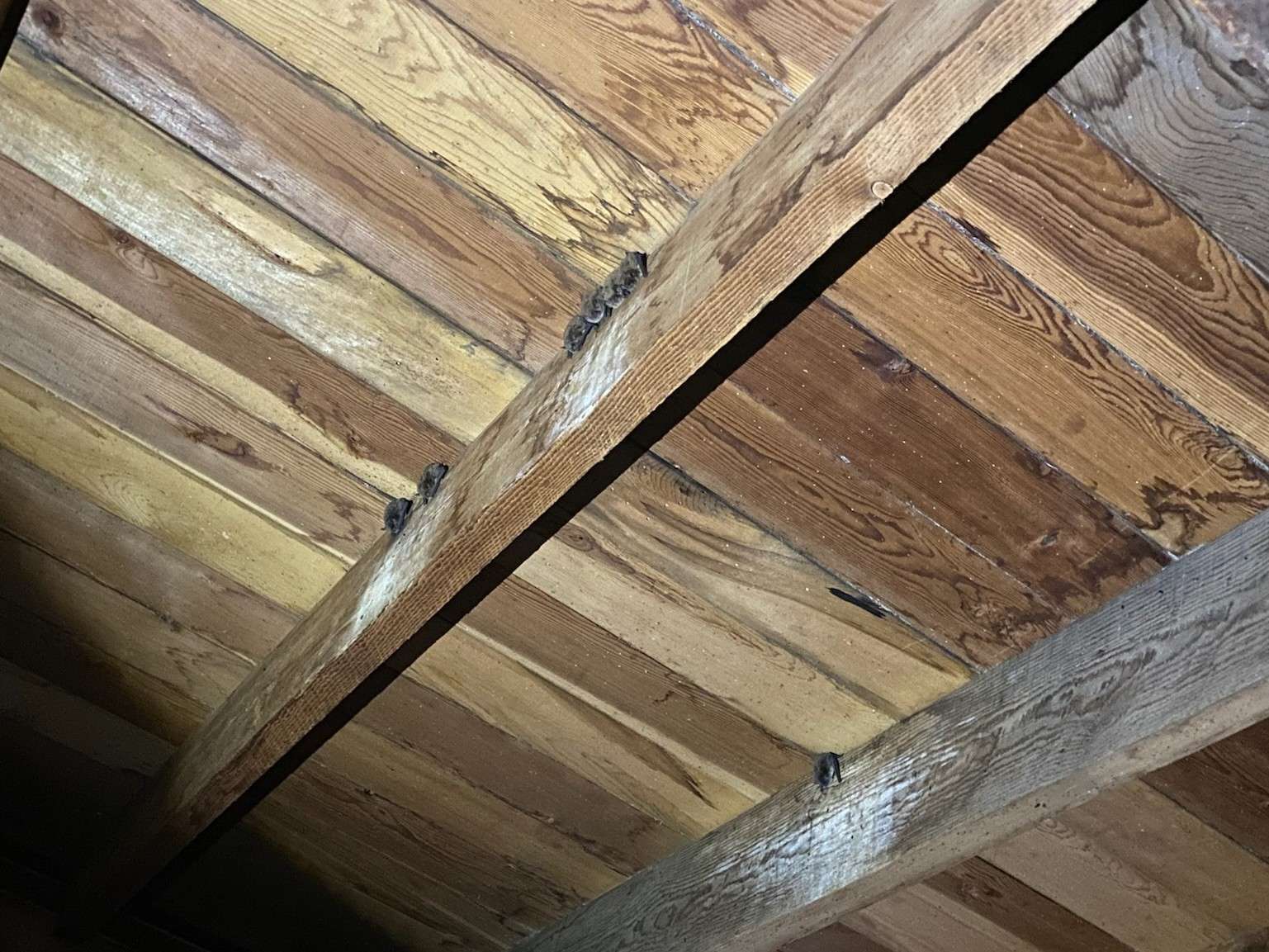
There’s no need to panic if you find bats in a building. Bats are simply small animals trying to find a suitable home, and many colonies can remain safely in a building without creating any risk for humans. What you should do depends on whether you have a single bat to remove or an established colony to manage.
Need to remove a single bat from a specific spot? See a bat inside, a bat on an outside wall, or a bat in awnings.
First, assess.
Before disturbing a colony, work out what kind of roost you have and whether the bats are truly a problem, or whether you can comfortably co-exist.
Assess what kind of roost you have
Night roosts are places bats use temporarily during the night to rest between feeding bouts. Residents rarely see the bats themselves, instead they notice droppings each morning where the bats were the night before. Day roosts are sites where bats gather to sleep and live during the day. They may be used by lone bats or by a colony of females and their pups (a maternity roost, only one pup per female). Usually these are crevices or hidden spaces where bats are protected from the elements and predators.
Assess your situation
Are the bats causing a problem? If so, is it the bats themselves, or the side effects of the bats, noise, smell, or guano, that are the issue? If the bats are using an outbuilding such as a barn or storage shed, you may be able to avoid contact with them and co-exist. Some people have lived with bats in their attic for decades, simply because they never come into contact with them and there are no issues of noise or smell.
To decide whether you really need to remove the bats, first identify the problems they are creating. Most people’s problems are a by-product of the bats, noise or smell, rather than the bats themselves.
Noise & guano.
Often you can solve the real nuisance without evicting the colony at all. Bat noise and guano can be addressed by the following:
- Remove accumulated guano (and collect any bat mummies for data).
- Install a plastic barrier on the floor and caulk the floor joints to prevent odour moving into human living quarters.
- Replace stained insulation.
- Install a pre-sealed plywood floor along human access routes and under the roost(s) to catch guano and make annual removal easier.
- Note that hard-to-access roosts will need special modifications and maintenance.
Exclude safely.
Leaving bats where they are is usually the best option for bat conservation, but it isn’t always right for every homeowner. Where bats persistently find their way into living spaces, or guano can’t be regularly cleaned out, exclusion may be the best option.
The right window
Follow best management practices and only exclude between September 1st and April 30th. In some regions of BC bats arrive earlier, so exclusions may not be possible in April either. The best time to exclude is in the fall, when bats are still active but in the process of leaving the roost for winter. If you live on the coast or in southern BC, exclusions during winter are not recommended either, as bats may be hibernating in the building.
Sensitive methods to try
Effective exclusions usually take several years. Work through these gentle methods in order:
- Find where the bats roost. Bats may use many parts of a structure, under roofing, siding, fascia boards, flashing and rafters; in cracks in the chimney or walls; behind shutters; or under a porch roof. You might find some of these spots acceptable and others not.
- Install bat boxes in ideal spots nearby before you exclude the bats, so they have somewhere else to go.
- Wait until fall or spring, after bats have hibernated or migrated, before disturbing the colony.
- Use a one-way exit device so bats can leave but can’t get back in. Once the roost is empty, seal every crack to evict the bats for good. Bats squeeze through spaces as small as 12 mm (½″), so make sure all gaps are thoroughly sealed.